Skeena River Lodge | Three Rivers

Published2024/10/22
Words byAlvaro G. Santillan
PhotographyAlvaro G Santillan
Fresh steelhead, swung flies and the people who help us see the water differently. A fly fishing experience at Skeena River Lodge, Guideline's new Partner Lodge in British Columbia and the three rivers they operate during the fall run: the Skeena, the Kalum and the Copper.
At Skeena River Lodge, the fishing carries on in conversation. The angle of a cast, the speed of a fly, the possibilities of a particular pool follow us back from the river and find their way into the next day's fishing. It is easy to feel at home among people who can spend as long discussing how the perfect swing feels as the size of the fish that took it.
Fresh steelhead, still bright from the sea, are the shared obsession. During our visit, the Skeena, the Copper and the Kalum offered three different ways of pursuing them. Moving between these rivers kept us engaged. Just as we settled into the demands of one, another called for a change of approach.
The scale of the Skeena
For a European angler, the magnitude of this watershed takes some absorbing. Those of us who fish for Atlantic salmon know large rivers and fish that travel far inland. Even so, the Skeena stretches our sense of proportion. The volume of water is only the most obvious part. Beyond it lies a network of tributaries, each with its own character and its own timing.
"The Skeena is the highway. The tributaries are home", said Jack Yoo, our guide for the Skeena.
By August, summer steelhead are moving through the main river, sometimes covering considerable distances in a short time. Fish bound for one tributary do not necessarily arrive alongside those heading for another. Following these movements, and knowing when a particular river might offer its best fishing, is a large part of the value of spending time with people who know the system throughout the season.
Then there are the fish themselves. Their size is remarkable well before the conversation turns to exceptional specimens. The possibility of a steelhead around thirty pounds can occupy a rather unreasonable part of an angler's mind. Such fish are rare, of course. But the prospect follows us into the next pool, and it is difficult to look at so much water without imagining what might be travelling through it. The Atlantic salmon angler in us recognized that feeling immediately.
Fishing the three rivers
The Copper brings the fishing into focus. Its defined pools give the eye something to work with, and the pleasure lies in shaping a presentation around what we can read. Where will the fly begin to fish? How will that change in current affect the swing? What's the best angle for that tail out? When should I mend? We enjoy this attention to detail, following the swing and trying to picture what the fly is doing beneath the surface.
On the Skeena, the field of view opens again. There is more water to search, and more room to become distracted by everything beyond the reach of a cast.
"Fish the river within the river," Jack repeated several times.
His words brought the fishing back to a scale we could work with. The water within our casting range was our river: its currents, its changes of pace, the shallower water on the inside. Each cast gave us a piece of it to fish properly. Distance had its place, provided we could still control the line and let the fly complete its swing. The Skeena could carry on being immense beyond it.
The Kalum sits somewhere between those two experiences. It has enough scale to keep you searching, while drawing your attention back to the finer work of presentation. Here, our guide Brandon Eddy asked us to pay closer attention to depth: getting the fly a little farther down and keeping it there through the part of the swing that mattered. The emphasis changed again, as it would between different sections of the same pool.
The people who shape the fishing
The guides at Skeena River Lodge share a dedication to steelhead, but each brings a personal way of approaching the water. One favours a squarer cast; another starts closer to forty-five degrees. They may look for a faster fly or a slower swing, mend upstream or downstream. Fishing with different guides gives you time to understand the reasoning behind these choices and feel their effect on the line.
For us, that is one of the pleasures of fishing with people who care deeply about their craft. It is easy to fall into familiar patterns, however much experience we have. Another angler can make us look again at water we would otherwise fish almost automatically, and give us a reason to try something else.
Steelhead leave room for that individuality. There is scope to develop a style and enjoy the way you cast and the way your fly swims. The more approaches you understand, the more deliberately you can choose your own. What you learn from one guide remains available when you fish with the next, and eventually finds its way into your fishing at home.
The tackle behind the swing
We did most of our fishing with the new NTX 12'9" #8/9 and 13'9" #9/10 double-handers and the NT11 in the same range.
On the Copper, we valued the shorter rods for their precision and ease of handling, paired with Compact Scandi Multi Tip set ups. Some pools are a bit tighter and the Compact Scandi allowed us to handle our anchoring with ease and be a bit more accurate controlling the swing in pocket water.
On the Skeena, the extra length and line weight gave us more scope to cover water and manage the swing at distance. We chose then the Classic Scandi Multi Tip. Together, the two outfits suited the variety of water we encountered.
With fish of this calibre, we want a reel whose drag we can trust without giving it another thought. The Scandi and Aura combined that dependable drag with the quick line pick-up of a large-arbour spool. Retrieving more line with each turn of the handle is a welcome quality when a fish turns towards you and you need to stay in contact. And steelhead are well known by their acrobatics and changes of speed and direction.
The most interesting decisions, though, concerned the lines.
Steelhead on the move, or resting undisturbed, can favour surprisingly shallow water, often beneath a broken, choppy surface. That includes the shallow water close to our own bank. In such water, a full-sinking line can settle too deeply and lose speed as it comes into the shallows. The fly slows with it, and a promising presentation can come to a lifeless finish.
The Scandi multi-tip system built around a floating body was ideal for this work. The body stays on the surface, where I can mend it and influence the fly's swing and pace. Interchangeable tips let us make smaller adjustments to depth while retaining that control. With a suitable tip, we can follow the swing all the way in, keeping the fly swimming through the shallow inside water. Lifting too early would leave part of that water unfished.
Guideline's Classic Scandi and Compact Scandi were outstanding here. The Compact's shorter body made precise casting comfortable in more confined water; the Classic's longer body came into its own when there was room to extend the cast and cover a broader sweep of river. Both let us adapt the swing to the water in front of us. Choosing the body was the starting point. The tips allowed us to refine the presentation as we moved through a pool.
This is why we want a selection of tips in my pocket, where changing one is little trouble. It is tempting to find a comfortable casting rhythm and fish a whole pool with the same configuration simply because it feels good. Yet the depth and pace of the water may change several times on the way down. A tip that suited the head of the pool may need replacing farther along, with another adjustment before the shallower tail. We spend enough time wondering where the fish might be. It is worth taking a moment to consider whether our fly is still reaching them as we intend. Sometimes the difference between a response and an uneventful pass lies in a change we could not quite be bothered to make.
The tackle we recommend for Skeena River Lodge



NT11 6-piece double handers are made with state-of-the-art graphite materials in a travel-friendly package without compromising the performance. Built to take Scandi-style fishing to the next level.
Read moreNT11 Double Hand 6-PC
1 150.00 USD


The Guideline Scandi fly reels are precision-engineered for modern migratory fly fishing, featuring high-torque titanium drag systems, deep large-arbour spools, and ultra-smooth braking performance. Designed in Scandinavia and built for power, balance, and control in every fight.
Read moreScandi - Black/Blue
675.00 USD


Guideline Aura fly reels elevate performance into beauty — light, strong, and elegant in every detail. The lightweight construction complements modern fly rods, and the fully sealed carbon-fibre drag system delivers smooth, consistent resistance in both fresh and salt water. With seven models and three colors in the range each size is carefully matched to its purpose, from light trout to heavy salmon setups.
Read moreAURA Titan
425.00 USD

The new Classic Scandi body is definitely our most “easy to cast” multi tip shooting head so far. With a perfect mix of lengths, weights and densities you will cover any situation you might face by the river.
Read moreClassic Scandi Multi Tip Body
99.99 USD
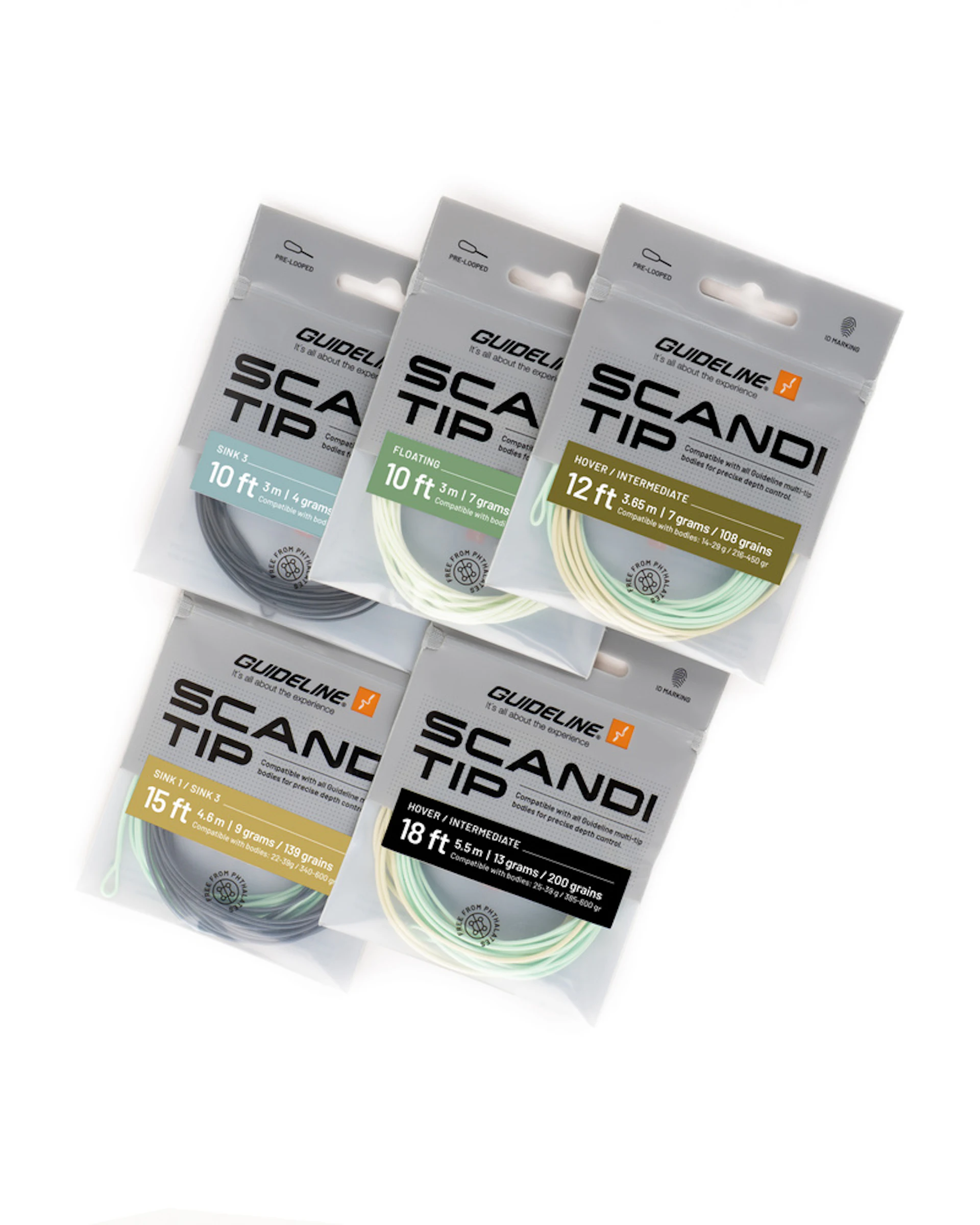
The extensive range of Guideline Scandi Tips covers everything from light single-hand rods to the big heavy double-handers, designed to perfectly match our multi-tip bodies. Multi-tip lines are the perfect choice for all types of salmon and migratory fishing as well as trout spey.
Read moreScandi Tips
39.99 USD

Razor sharp, super strong tube and fly hooks with outstanding quality manufactured in carbon steel with black nickel finish.
Read moreSingle Tube Hook
18.00 USD
The way we let them go
At Skeena River Lodge, the care given to releasing a steelhead felt as much a part of the fishing as the cast or the swing. There was a respect for how it was done that stayed with me. The single barbless hook belonged naturally to that culture, making unhooking simpler and helping keep handling brief.
It also made us reflect on the European salmon and sea trout fishing we know, where double and treble barbed hooks are still the norm. We share that wish to return our fish, but familiar hook choices can be surprisingly difficult to question. A barb offers a certain reassurance, whether or not we need it. Seeing single barbless hooks treated so naturally encouraged us to look again at our own habits.
Perhaps we lose the occasional extra fish this way; perhaps we do not. Either way, we are happy to accept a little less margin for error during the fight. Staying in contact, managing the pressure and reacting as the fish changes direction are part of the skill. If a moment of slack costs us a fish, there is something for us to improve. We are fly anglers, after all. We did not choose this because it was easy.
In practice, we did not notice that we were losing significantly more fish. That is simply our experience of the trip, but it was enough to settle the question. Next season, single barbless hooks will be part of our sea trout and Atlantic salmon fishing from the first cast.
What the partnership can offer
The partnership between Guideline and Skeena River Lodge gives us, as guests, the chance to fish these three rivers with demo tackle carefully selected for their different demands. We can try different rods and line configurations with the guides’ help, feel how those choices affect the swing and find what suits our own fishing. That understanding travels home with us.
We also see an opportunity for that learning to work both ways. Guideline can draw on the guides’ daily experience to inform its tackle development, while SRL gains closer access to the knowledge behind the equipment and a connection to more anglers within the Guideline community. As guests, we benefit from having the tackle and the guidance considered together, around the water we come to fish.
We keep coming back to our guide’s words: “Fish the river within the river.” We can still picture the Skeena stretching far beyond our casts, and the shallow, broken water close to our bank that deserved every bit of our attention. Somewhere within reach, a fresh steelhead might be passing through. At SRL, we could share that fascination with guides who have made these fish and these rivers their life’s work. We would happily cross the Atlantic again to stand beside them, deciding where to make our first cast. That is where we want to be: a fly swinging across the current, the line under our fingers, and the anticipation of that unmistakable pull.
Stay dry and warm, enjoy your experience at Skeena River Lodge


The Guideline Loft Jacket is a lightweight, wind-resistant, and packable layer for fishing and everyday wear. Made from recycled materials and insulated with Guideloft™, it provides warmth, comfort, and practical features. It packs into its own pocket for easy storage.
Our model measures 183cm/80kg (6'0"/176 lbs) and wears size M
Loft Jacket Dk Gold/Iron
270.00 USD


The Guideline Loft Pants are a lightweight, insulated mid-layer for fishing and camp life. Made with recycled materials and Guideloft™ 40 g fill, it offers warmth, mobility, and packability. Designed to fit under waders and packs into its own pocket.
Our model measures 183cm/80kg (6'0"/176 lbs) and wears size M
Loft Pants Iron
250.00 USD